

As AI large model training continues to drive the adoption of 400G interconnects in AI computing clusters and data centers, network performance has become a critical factor in overall training efficiency. Large-scale GPU clusters rely on continuous data exchange across the network. Packet loss, jitter, latency spikes, llink flapping, or bit errors can lead to reduced training efficiency, GPU idle time, and even job failures. Therefore, validating an AI computing network is not simply about whether 400G throughput can be fully achieved. More importantly, it is about evaluating the network’s resilience, stability, and recovery capability when operating at full 400G load under abnormal conditions and network disturbances. In addition, AI large-model training is extremely sensitive to latency. Even minor jitter can negatively impact synchronization efficiency across computing clusters, ultimately affecting overall utilization of computing resources and training performance.
Issues in AI computing networks typically appear only under full-load, highly concurrent, and tightly synchronized conditions. A 400G network impairment emulator must inject packet loss, latency, jitter, bit errors, and other impairments at full line rate across varying packet sizes. Otherwise, it cannot effectively reveal switch buffering, congestion issues, or RDMA/RoCE NIC stability problems under real high-load scenarios. In large AI model training, collective communication latency directly affects overall training efficiency and sets the performance ceiling. Sub-microsecond latency is therefore a critical target. A 400G network impairment emulator must provide high-precision latency emulation with microsecond-level granularity.
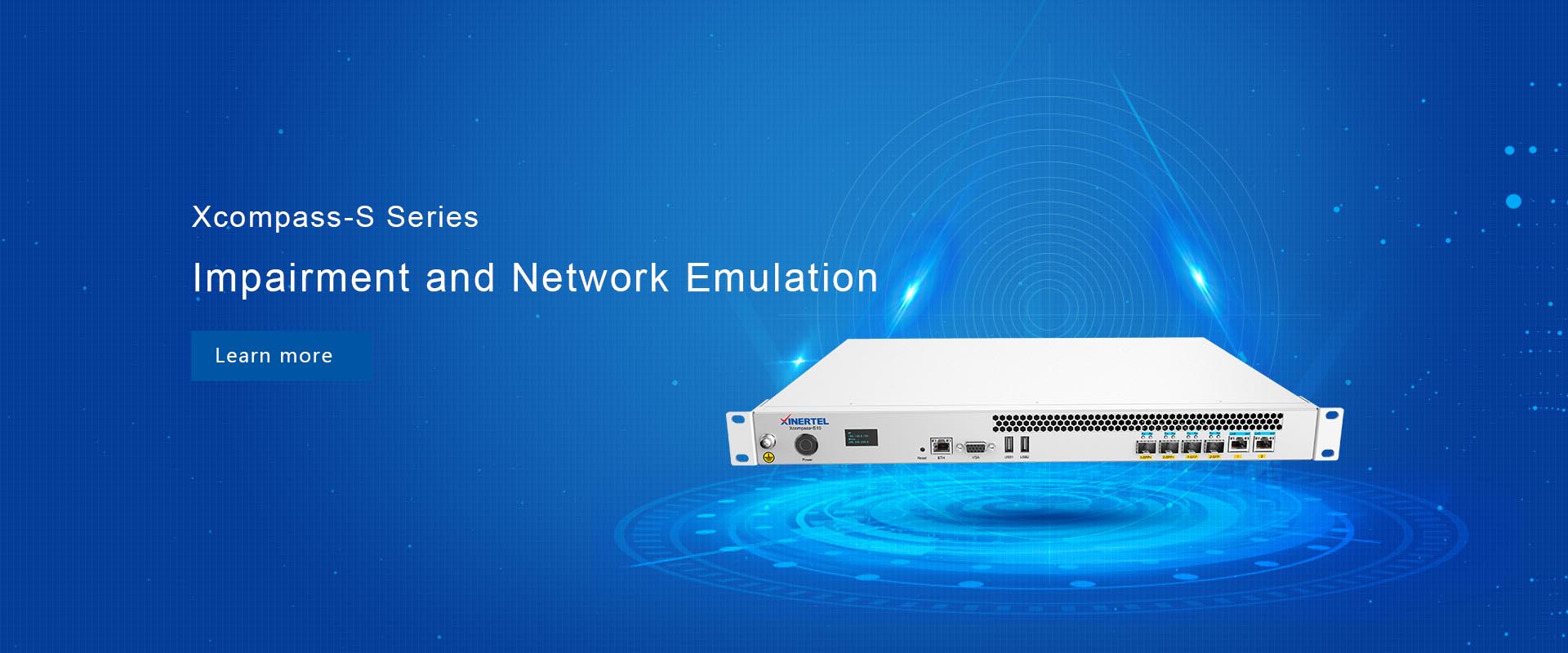
To address these requirements, XINERTEL has developed the Xcompass200 400G Network Impairment Emulator based on an FPGA hardware architecture, enabling high-precision latency emulation and line-rate impairment simulation across different packet sizes. The Xcompass200 supports line-rate impairment injection at 400G for packet sizes ranging from 64 to 16,004 bytes. It can apply impairments to mixed traffic consisting of both elephant flows and mouse flows at line speed, eliminating test distortion caused by impairment generator performance limitations. This enables users to evaluate the real-world performance of network devices under production-like traffic loads when exposed to packet loss, latency, jitter, bit errors, and link flapping.
The Xcompass200 supports a comprehensive set of network impairment simulations, allowing users to recreate a wide variety of AI network fault scenarios. For example, it can simulate micro packet loss and abnormal packet loss to evaluate device recovery capabilities. It can also emulate sudden latency spikes, with a minimum fixed latency of 4.5 μs and a latency adjustment granularity of 1 μs, meeting the requirements of highly time-sensitive network validation scenarios. In addition, network jitter can be introduced to verify RDMA transmission stability. Through precise impairment injection, users can quickly and accurately identify the factors that most significantly impact AI network performance.
Network failures in AI data centers are not limited to the traffic layer; they may also originate from physical links and packet-level errors. To address these scenarios, the Xcompass200 supports multiple impairment types, including fiber link flapping, CRC errors, and IPv4 checksum errors. These capabilities enable more realistic fault emulation and help users validate system fault tolerance and recovery mechanisms before deployment.
Beyond its powerful impairment simulation capabilities, the Xcompass200 also offers excellent scalability and deployment flexibility. The system adopts a modular chassis-and-card architecture. A single chassis supports up to two interface cards, and each card provides two 400G impairment ports, enabling a maximum of four 400G impairment ports per chassis. Measuring 442mm×125.2mm×426mm (W×H×D), the platform combines high performance with practical portability. In addition, each port group supports eight independently configurable bidirectional impairment profiles, allowing users to build diverse test scenarios with ease.
With comprehensive impairment emulation and flexible deployment options, the Xcompass200 is ideal for multiple scenarios. It helps engineers validate device reliability under challenging network conditions during product development, reproduce real-world network anomalies during deployment and acceptance testing, optimize network performance through precise impairment simulation, and support network research, education, and innovation with realistic test environments.